Feedback to the European Commission’s call for evidence on SMRs
In February 2024, the Commission launched the European Industrial Alliance on Small Modular Reactors (SMRs) to « ensure the successful deployment of the first SMR projects in Europe by the early 2030s ». In fact, the European Industrial Alliance on Small Modular Reactors has adopted its first Strategic Action Plan, outlining ten specific and targeted actions to deliver over the next five years.
Looking to « highlight key enabling conditions, potential barriers and concrete milestones in view of the future development and deployment of SMRs in Europe » the European Commission has opened a feedback period between 06 November 2025 – 04 December 2025 for the public.
In this context, Nuclear Transparency Watch (NTW) and the European Environmental Bureau (EEB) have jointly proposed a feedback underlining important aspects to be addressed when it comes to SMRs. You will find a synthesis of their contribution below (Click here to read the complete feedback):
« As organizations dedicated to transparency, public participation, and democratic decision-making in nuclear activities, NTW and EEB are highlighting the risks, inefficiencies, and democratic deficits associated with SMR development. In fact, they encourage the EU to prioritize renewable energy, energy efficiency, and demand-side solutions—technologies that are proven, cost-effective, and aligned with climate goals—rather than investing in unproven and high-risk nuclear technologies.
Key Concerns with the SMR Strategy
1. Safety Risks
2. Financial Risks
3. Harmonization and Industrial Challenges
4. Lack of Openness, Civil Society Participation and Public Debate
The European Commission’s SMR strategy lacks transparency, democratic legitimacy, and economic rationale.
Instead of pursuing costly, unproven, and risky nuclear technologies, the EU must:
1. Prioritize real climate solutions—renewables, storage, and efficiency – over SMRs that may not be operational before 2040 and not as low carbon as promoted.
2. Uphold strict safety and environmental standards with no deregulation for SMRs.
3. Ensure full financial accountability: developers must bear all risks, not taxpayers.
4. Address nuclear waste and supply chain challenges with no false promises on « solving » nuclear’s inherent problems.
5. Prioritize open, inclusive decision-making: civil society must have a real seat at the table where critical thinking and democratic debates should take place with no more industry-driven narratives without scrutiny.
In short, the EU’s energy future must be transparent, participatory, and sustainable while SMRs fail on all counts. Therefore, we urge the Commission to seriously revise this very flawed strategy. »
Contribution to the Review of the EU Taxonomy Environmental Delegated Act
NTW has contributed to the review of the EU Taxonomy Environmental Delegated Act which is open for public comments until 5 December 2026:
https://ec.europa.eu/info/law/better-regulation/have-your-say/initiatives/14874-Sustainable-investment-review-of-the-EU-taxonomy-environmental-delegated-act_en
Click here to find the contribution which in short calls on the European Commission to:
- Exclude nuclear energy from the EU Taxonomy due to its unsustainable and high-risk nature.
- Strengthen transparency by requiring verifiable, science-based evidence for all technical screening criteria.
- Enforce compliance with EU and Euratom laws on nuclear safety, waste management, and public participation.
- Update LCA methodologies to reflect real-world environmental impacts of nuclear energy.
- Prioritize renewable energy as the cornerstone of a sustainable and democratic energy transition.
Finally, NTW always welcomes any possibility enabling more transparency, public participation, and environmental justice in energy policymaking.
Concerns about potential inclusion of nuclear energy in EIB Green financing
The European Bank for Reconstruction and Development (EBRD) has invited the public to give its views on its policies and strategies. In fact, the new proposed institutional and operational policies as well as strategies for the countries of operations and sectors in which they invest are made available for public comment (for more information click here).
Based on its GET 2021-25, a systemic approach to supporting the transition to resilient, low-carbon economies, the EBRD has developed a methodology for green finance attribution to set out how the Bank determines whether or not EBRD finance should be classified as green, how to estimate the outcomes of green finance, and how to define plans for monitoring the delivery of those outcomes. This methodology is updating the previous “Technical Guide – Implementing the Green Economy Transition” and its annexes since August 2025 and it is now currently available for public comment.
In this context, supporting this effort of transparency and collaboration from EBRD in refining their methodology, NTW wanted to provide its comments and feedback on this updated methodology specifically in relation to nuclear energy to participate to strengthening the robustness and effectiveness of their green finance commitments.
Therefore, you will find here NTW’ submission on EBRD green finance attribution underlining 4 important reasons advocating against the possibility to consider the nuclear energy as sustainable or « green »:
1 – Radioactive waste and next generation
2 – Taxonomy and Do No Significant Harm (DNSH) principle
3 – Transparency in the cost of nuclear power
4 – Nuclear energy and climate change
Hybrid event on Small Modular Reactors (SMRs)
 Check out Nuclear Transparency Watch latest video on an hybrid event dedicated to cross-cutting views on Small Modular Reactors (SMRs)
 :
Thanks to Alexis Geisler-Roblin who moderated this event, complementary contributions were shared by speakers from the French  national agency for radioactive waste management l’ANDRA, from the new French regulator and technical support organisation l’ASNR, from the environmental NGO – member of NTW – Friends of the Earth Estonia
 and from the NGO based in the USA
 Nuclear Information and Resource Service.
national agency for radioactive waste management l’ANDRA, from the new French regulator and technical support organisation l’ASNR, from the environmental NGO – member of NTW – Friends of the Earth Estonia and from the NGO based in the USA Nuclear Information and Resource Service.The event address key questions such as perspectives on projects, waste management or regulations aspects. You will find below the presentations provided by the 4 speakers:
SMRs globally and in Estonia by Madis Vasser (FoE Estonia)
SMRs and waste in France by Virgine Wasselin (ANDRA)
SMRs and waste in France by Virgine Wasselin (ANDRA)
Adaption to the regulatory framework in France by Philippe Dupuy (ASNR)
👉 for more info from ASNR on this click here (only in French for the moment)
👉 for more info from ASNR on this click here (only in French for the moment)
📕 Book release – Transparency and Public Participation for Radioactive Waste Management in Europe
Some members of NTW have collectively published a book, on Transparency and Public Participation for Radioactive Waste Management in Europe investigating how the pillars of the Aarhus Convention, and a broader understanding of transparency by Civil Society (CS), can be transposed into Radioactive Waste Management (RWM), particularly in the establishment of Radioactive Waste (RW) facilities in different national contexts.
With an analysis of nine national cases from Europe, the book provides the results of the investigations, including comments, suggestions, questions, and other observations, collected in interaction with other EURAD-1 participants from civil society. It discusses the feedback provided within a questionnaire completed by ROUTES members for the development of national programmes on radioactive waste management submitted to the waste directive, based on effective access to information, public participation, justice, resources, and transparency.
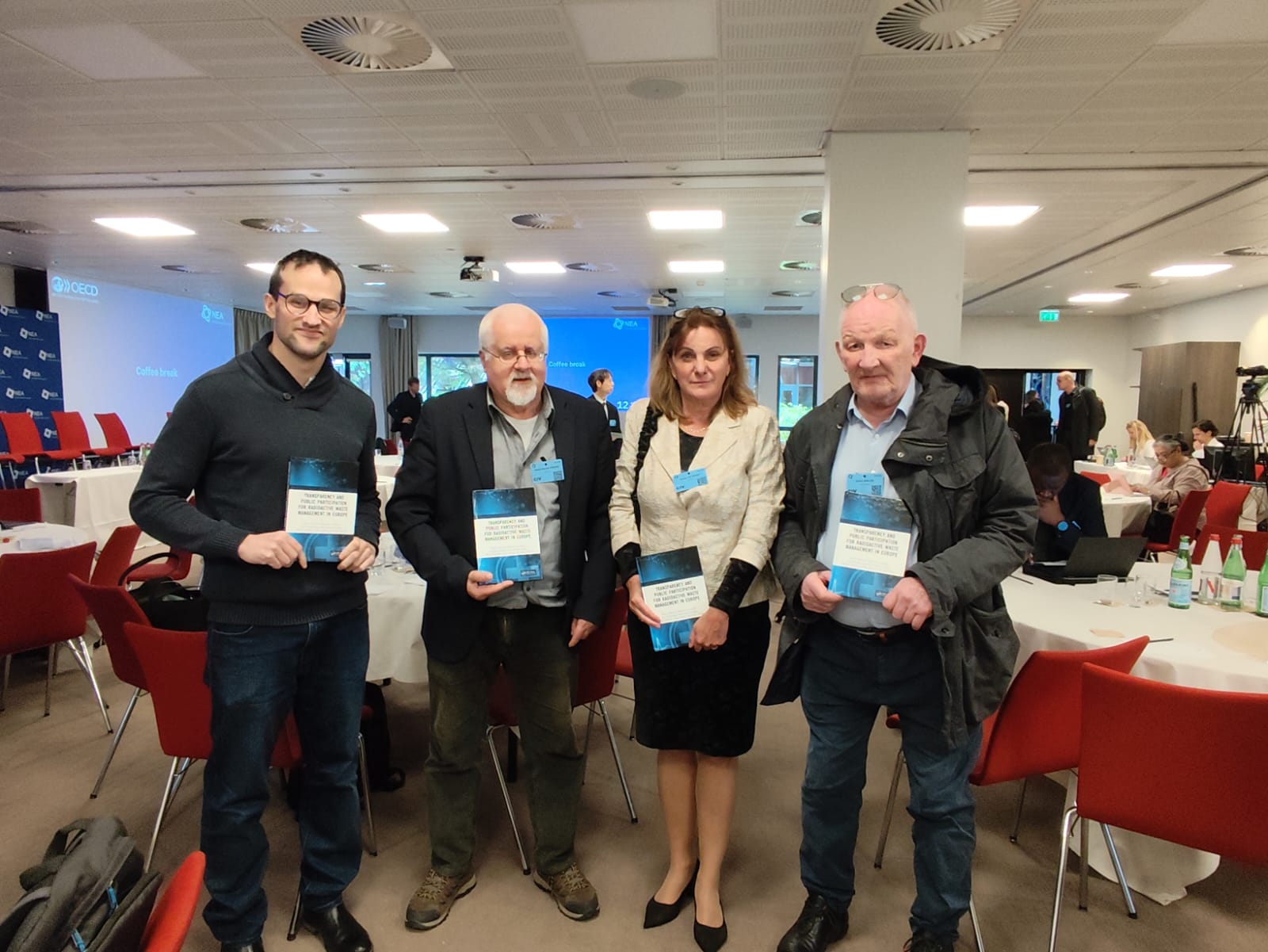
The book will interest nuclear energy policymakers, government employees, and radioactive waste management facility operators. It will also aid researchers and academics investigating public perception and facility siting considerations.
Citizen scientist Andrey Ozharovskii detained by Mongolian authorities after measuring radiation levels near uranium mines
Nuclear Transparency Watch, including our colleague Jan Haverkamp, has published an open letter regarding the arrest of physicist and environmentalist Andrey Ozharovskii in Mongolia.
Andrey Ozharovskii was detained by Mongolian authorities while measuring radiation levels with a personal dosimeter near uranium mining sites operated by the French company Orano. Although released, his passport has not been returned, and he faces uncertainty about his freedom of movement.
Ozharovskii’s activities form part of a long-standing European tradition of “citizen science” in the nuclear field: independent experts and local communities taking radiation measurements to help ensure transparency, safety, and accountability. Nuclear Transparency Watch and its members have supported such initiatives across Europe in cooperation with regulators, laboratories, and NGOs.
The principle at stake is simple but crucial: environmental information, including radiation data, must be accessible to the public. This is at the heart of the Aarhus Convention, the international treaty guaranteeing the rights of access to information, public participation in decision-making, and access to justice on environmental matters. Under its Article 3(8), people exercising these rights must not face persecution or harassment.
Mongolia is currently considering accession to the Aarhus Convention. This incident highlights why such commitments matter: ensuring that those who act to protect the public and the environment can do so without fear. At this moment, Andrey Ozharovskii should regain access to his ability to travel freely.
You can read the open letter here.
Rolling stewardship in radioactive waste management
In the frame of the EU joint programme on radioactive waste management EURAD-1, the NTW members involved, together with other civil society members and EURAD participants, addressed aspects of rolling stewardship in radioactive waste management in the context of research and fruitful Interactions with Civil Society (ICS) methodology.
This helped in developing the following outputs within the 2 « strategic studies » work packages in which NTW was participating:
- UMAN work package where a presentation of rolling stewardship with regard to human uncertainties:
➡️ ICS workshop Ljubljana intergenerational stewardship culture final
and various drawings from different authors to have visual representations of the concept:
➡️Visual representations of rolling stewardship - ROUTES work package where the section 6.4 of the deliverable D9.18 was dedicated to Rolling Stewardship which can be described as a strong version of Long-Term Stewardship (LTS) of Radioactive Waste:
➡️ https://www.ejp-eurad.eu/publications/eurad-d918-implementation-routes-action-plan-third-phase
In parallel, NTW also launched a working group on this topic in which several presentations have been made by knowledgeable speakers from various backgrounds and with complementary knowledge such as Robert Del Tredici, Dr. Gordon Edwards, Marcos Buser, Reinhard Uberhost or Maryna Surkova. For NTW, Niels Henrik Hooge and Gilles Hériard-Dubreuil also provided some inputs.
The following presentations proposed in this working group are also available on NTW’s You Tube channel:
- Webinar #1
“Human uncertainties relevant to the safety associated with radioactive waste management and Rolling Stewardship”
by Niels Henrik Hooge Master of Laws and Master of Arts in Philosophy. Interested in environmental and sustainability for a long time he has manifested itself in activism, cooperation with green NGOs in Denmark and abroad, as well as in many types of writing. In addition to editorial staff work in Danish environmental magazines, he has published several books, including most recently the novel “Kosova” (2016) and the poetry collections “Grøn nation” (Green Nation, 2015), “Miljødigte” (Environmental Poems, 2018) and “Miljødigte 2” (Environmental Poems 2, 2019).
“The origin and evolution of the concept of Rolling Stewardship”
by Ph.D. in Mathematics and Master of Arts in English Literature, Gordon Edwards, who has been a Professor of Mathematics and Science during all his career during which he did many publications in that field but not only. From 1970 to 1974, he was the editor of Survival magazine. In 1975 he co-founded the Canadian Coalition for Nuclear Responsibility and has been its president since 1978. Edwards has worked widely as a consultant on nuclear issues and has been qualified as a nuclear expert by courts in Canada and elsewhere. - Webinar #2 – part 1
Webinar #2 – part 2
“History of disposal projects and need for stewardship »
by Marcos Buser, a geologist with a degree from the Swiss Federal Institute of Technology (ETH) in Zurich, also consultant and expert who has been active for more than four decades in the management of industrial and radioactive waste projects, and a former member of several scientific commissions for the Swiss government, including the Swiss Federal Commission for Nuclear Safety. He was a member of the StocaMine steering committee. - Webinar #3
« An Introduction to Safety Culture – a possible resource for Rolling Stewardship of Radioactive Waste Management ? »
by Gilles Hériard Dubreuil, born in 1957, has a background in mathematics and human sciences (sociology, ethics, risk management). From 1982 to 1990, he worked for various consulting firms, then for Mutadis from 1991 onwards, developing research and consultancy activities in the fields of governance of high-risk activities and sustainable development, as well as in the design and testing of democratic governance systems at local, national and international levels.
« Rolling Stewardship – Safety Culture ; a regulatory perspective »
by Maryna Surkova a professional at the Federal Agency for Nuclear Control (FANC) in Belgium where she oversees nuclear safety and regulatory affairs within the Ghent metropolitan area. Maryna holds qualifications from the SCK CEN Academy for Nuclear Science and Technology. With a strong technical and regulatory background, she ensures compliance with national and international nuclear standards. Based in Belgium, she combines scientific expertise with policy implementation to support FANC’s mission.
In fact, NTW has envisioned connected topic related to the concept of Rolling Stewardship addressing challenges of the long-term engagement and maintenance in various way, such as « Intergenerational Stewardship » or « Long-term Stewardship » for instance. This work is meant to be continued within the same platforms which were previously used such as the SITEX.network and EURAD but also with any interested partners such as researchers specialized in environmental stewardship or in radioactive waste management in the long term.
In order to help further research on this topic, Niels Henrik-Hooge, has developed a paper providing a synthetical overview of the different concepts and perspectives related to radioactive waste management in the long-term such as « Intergenerational Stewardship culture », « Rolling stewardship » or « Long-term Stewardship »: ➡️ Rolling stewardship and management of radioactive waste in the long-term ⬅️
This is why, a « stewardship culture » could be defined as a democratic and sustainable way to inclusively and pluralistically roll accountability and management across generations in the long term, in the spirit of the Aarhus Convention.
« Mining Companies In Greenland Should Be Better Controlled » 🇬🇱 NOAH
NOAH, the Danish member of Friends of the Earth (Foe), and member of NTW, has just release the following press released advocating together with the green NGO Australian Conservation Foundation (ACF) and Urani Naamik-Nuuk that « Mining Companies In Greenland Should Be Better Controlled ».
To know more about the Institutional mechanisms in Greenland to facilitate transparency and public participation in radioactive waste management in general, Niels Henrik Hooge, member of Nuclear Transparency Watch and NOAH Friends of the Earth Denmark, wrote an article about it in the EURAD deliverable D9.17 ROUTES – Implementation of the ROUTES ICS action plan second phase (p. 91).
This article was also presented orally in the frame of a webinar series (click here to watch).


Nuuk, Copenhagen and Melbourne, June 9, 2025
PRESS RELEASE
Mining Companies In Greenland Should Be Better Controlled
On May 29, the owner of the large Kuannersuit/Kvanefjeld uranium and rare earths mining project, Energy Transition Minerals (ETM), held its annual general meeting in Melbourne, Australia. The mining company has sued the Danish and Greenlandic governments for 10 billion EUR – equivalent to almost four times Greenland’s GDP – which is likely to make the case the largest in the history of the Danish Realm.
“For more than ten years, ETM has tried to force through a mining project that few residents in Greenland want,” says Erik Jensen, chairman of the URANI? NAAMIK / The No To Uranium Association in Nuuk. “The general meeting shows that the mining company has learned nothing and has no respect for the local population. Apparently, ETM still spares no effort to promote its project, even though it has been illegal for four years.”
One of the participants in the general meeting was Dave Sweeney from the green NGO Australian Conservation Foundation (ACF), who ensured that shareholders could ask questions of ETM’s management. His briefing from the meeting demonstrates that ETM does not deny that Julie Bishop, a former Australian foreign minister, who has been hired as a strategic advisor to promote the Kuannersuit/Kvanefjeld mining project, may be liaising with the Trump administration. She is already accused of double play in Myanmar, where she is both a UN special envoy and a lobbyist for Chinese mining companies. 290 environmental organisations have signed an open letter to the UN Secretary-General, calling for an investigation into the conflict of interest.
“The Australian uranium sector has over-promised and under delivered for decades”, says ACF nuclear analyst Dave Sweeney. “This history of leaks, damage and division has seen sustained and often successful community resistance to uranium mining. We do not want Australian mining companies seeking to ignore or override community concerns in Greenland. People must have a right to choose their future and to say no to mining and ETM and other companies must listen”.
Since the lifting of the ban on uranium mining in 2013 which ETM pushed through by threatening the Greenland government that it would not extract rare earths in Kuannersuit if uranium could not be mined, the company has only caused problems. This could have been prevented twelve years ago when questions were raised in the Danish and the Greenlandic parliaments about, among other things, the ETM ownership group’s alleged connection to organized crime in Australia.
“The fact that dubious mining companies can gain access to license areas is still a problem,” says Palle Bendsen from NOAH Friends of the Earth Denmark. “Together with three European and two Australian environmental organizations, NOAH complained to Nasdaq in late 2024 about the Australian-American mining company Critical Metals Corp. The company is on its way to take over Tanbreez Mining Greenland A/S, which owns the large Kringlerne/Killavaat Alannguat mining project in South Greenland. The deposit is reportedly the largest occurrence of rare earths in the world. Our complaint documents that Critical Metals Corp has misled the public, the authorities, and current and possibly future shareholders in at least twelve cases.”
After Donald Trump threatened to annex Greenland, the more than hundred large-scale license areas pose not only a serious environmental, but also a security problem. Together, they cover a fifth of Greenland’s habitable areas and instead of occupying the country with military means, Trump-supporters can buy it up piece by piece. For example, the American investment company GreenMet has 10 billion USD at its disposal for investments in Greenland. The company’s management includes a former Senior Advisor to the Director of National Intelligence and National Security Special Operations Advisor with a history as a Commander of a Special Operations Detachment in Afghanistan, a former highly decorated Special Forces Weapons Sergeant with more than 10 years of experience in special operations, an ex-CIA operative, and a former Director of Oval Office Operations, who used to be head of security for the Trump Organisation, while serving as Donald Trump’s personal bodyguard.
“With only a handful of employees, the Greenlandic Department of Mineral Resources has no chance of controlling the many mining areas, let alone who owns the companies that possess the licenses,” says Niels Henrik Hooge from NOAH Friends of the Earth Denmark. “Based on the experience with ETM, the Department can’t count on much support from the Ministry of Defence and the Ministry of Justice in Denmark, which together with the Greenlandic authorities are responsible for security and law enforcement in Greenland. Both the Greenlandic population and Greenlandic politicians want a closer relationship with the EU, so perhaps Denmark could use its upcoming EU Presidency to promote Greenlandic interests. Simultaneously, a moratorium on large-scale mining could be introduced for the next four years in order to protect the environment and avoid unwanted interference from the outside.”
Australian Conservation Foundation’s briefing on ETM’s annual general meeting
Regarding Energy Transition Minerals, etc., see: Mariane Paviasen and others, Greenland Is Under Attack, Nuclear Monitor #917, June 28, 2024, p. 8-12
For more information, contact:
URANI? NAAMIK / The No To Uranium Association in Nuuk: Erik Jensen, Tel.: +299 496790, E-mail: erikjensen1967(at)icloud.com
NOAH Friends of the Earth Denmark: Niels Henrik Hooge, Tel.: +45 21 83 79 94, E-mail: nielshenrik(at)noah.dk and Palle Bendsen, Tel.: +45 30 13 76 95, E-mail: pnb(at)ydun.net
Australian Conservation Foundation: Dave Sweeney, Tel.: +61 (0)408 317 812, E-mail: dave.sweeney(at)acf.org.au
Illustrative Programme for Nuclear Energy (PINC)
🇪🇺🔎 Nuclear Transparency Watch participated to the Illustrative Programme for Nuclear Energy (PINC) in 📅 May 2025 to address the following question:
On what ground could the 🇪🇺 EU support the «nuclear revival» ☢️📈 supported by some Member States ?
The following feedback can be found here.
« First and foremost, its important to recall that the countries supporting this revival are obviously mostly concerned and interested – they are operating nuclear energy and even industrializing it – and those 13 EU Member States are led by France a country reported to be lacking democracy in energy debates in various occasions including currently with the PPE (Programmation Pluriannuelle de lEnergie).
Also, before addressing this revision of the EUs Illustrative Programme for Nuclear Energy (PINC) in itself, its interesting to look back at the 2016 PINC which projected 14 GW of new nuclear capacity by 2025 when only 3.6 GW materialized because promises and reality are two different things especially when it comes to energy production which requires safety, time and a certain stability both political and financial. Today, the political situation in the EU and worldwide is more polarized and uncertain than ten years ago, in 2022 Vladimir Putin invaded Ukraine leading to many issues around the Nuclear Power Plants there (Chernobyl and Zaporijia) and this year Donald Trump has created some major instability on the markets over night with its Liberation Days tariffs showing the economical vulnerability and dependency of most of the countries in the world. Therefore, when it comes to energy its crucial to have a broad and transparent perspective to support more easily EUs values and strategy because Europes current reliance on Russian uranium (valued at over 700 million in 2024) contradicts its sanctions regime for instance in addition to weaken its energy security (NTW supports the EU Commission’s roadmap for ridding itself of energy imports from Russia, including uranium and nuclear fuel published yesterday).
Furthermore, nuclear energy is highly represented in the EU – with around 100 operating reactors – compared to other regions in the world, but also not new. Its aging nuclear infrastructure (e.g., Frances fleet with an average age of 37 years) is in fact increasingly vulnerable to both climate change and cyber or military threats. In addition the nuclear sector is also aging and declining with more decommissions than new builds which face chronic delays and cost overruns (e.g., Flamanville-3 (France) and Olkiluoto-3 (Finland) – took over a decade longer than planned).
Instead of promising a «nuclear revival» to achieve carbon neutrality, the EU should focus on safety of the existing nuclear facilities including radioactive waste for which there isn’t yet any proven solution for the thousands of years ahead of us. In fact, from 2009 to 2024, nuclear Levelised Cost of Energy (LCOE) rose by 49%, while that of solar PV and wind decreased by 83% and 63% respectively providing quicker returns and less financial risks (WNISR 2024). Furthermore, nuclear energy’s exposure to climate-related disruptions such as droughts and heatwaves, which reduce reactor cooling efficiency and increase shutdown risks should also be compared to other source of energy because this undermines its reliability in a warming climate.
The European Commissions decision to allow only 4 weeks for public consultation after an 8-year gap is questionable especially when EU countries have also proven to be undemocratic on this topic. In the eye of trust building and citizen engagement, its important to be ambitious in including public in a meaningful way.
For those reasons, NTW believes that the main concern and interest should remain the safety of the life around the existing nuclear installations still operating or decommissioned before anything. Democratizing nuclear energy is a key aspect for safety and transparency especially nowadays with the serious economic, security and military challenges we’re facing, therefore resources should be given to citizens willing to engage beyond polarization and distrust to overcome potential misinformation or opacity. »
Tanja Perko, Nadja Zeleznik (NTW Chairwoman) and Peter Mihok (NTW member) have translated recent social science and humanities research (2020–2025) into evidence-based recommendations for policymakers managing societal aspects of radon and naturally occurring radioactive materials (NORM).
By bridging the gap between researchers and decision-makers, this work ensures that radon and NORM policies are informed by robust evidence, context-sensitive insights, and tested approaches.
Full paper -> Click here
#newpublication #scientificpaper #radon #NORM #SSH #policy #decisionmaking