Lancement de Nuclear Transparency Watch par EurodeputesEE
Bruxelles, European parliament, 7th November 2013
Press conference for the launch of the network Nuclear Transparency Watch
Prevent and anticipate through transparency and participation
Lancement de Nuclear Transparency Watch par EurodeputesEE
Bruxelles, European parliament, 7th November 2013
Press conference for the launch of the network Nuclear Transparency Watch
The Japanese government has delayed a planned announcement on the country’slong-term energy strategy amid signs of rising public concern about a return to nuclear power.
Russian nuclear power company Rosatom will expand Hungary’s only nuclear power plant, more than doubling its capacity in the biggest construction project in Hungary’s post-Communist history. Read this article
Trial of the 29 activists from Greenpeace who entered a French nuclear Power Plant at Tricastin in Southern France. They wanted to denounce the security failures of nuclear power plants.
The United Kingdom and the Czech Republic have opposed calls by eight EU member states to introduce a renewable energy target for 2030, claiming the EU’s future climate and energy framework should be technology neutral and allow nuclear energy among other sources. Read this article
The ‘Energy – Transparency Centre of Knowledge’ (E-TRACK) is a joint initiative agreed between the Directorate General for Energy (DG ENER) and the Joint Research Centre (JRC) of the European Commission for the promotion of public participation in the implementation of energy policies. It results from the recognition of the need to offer a reliable source of information on matters relating to energy policy implementation.
The objective of E-TRACK is to become a central point of reference for monitoring, disseminating and sharing information on good practices of public participation in energy policy implementation across the EU. E-TRACK will conduct several projects on transparency and public participation in multiple energy sources. Each project will relate to a network of actors from civil society, national and subnational authorities, pertinent international organizations, regulatory or supervisory bodies, and industrial and commercial interests.
E-TrackPublic participation in radioactive waste management (RWM) constitutes the first project of the Energy – Transparency Centre of Knowledge (E-TRACK). Given the legally binding requirements for transparency of the Council Directive 2011/70/EURATOM on spent fuel and radioactive waste, the European Commission considers it useful to provide steady and continuous support in the very near future.
Focus-Association for Sustainable Development organised in Ljubljana, the capital of Slovenia, on December 2 2013 a conference on « Nuclear Energy and Public Participation » with participation of experts from URSJV- Slovenian Nuclear Safety Administration, IRSN- Institute for Radiological Protection and Nuclear Safety from France, ANCCLI – French National Association of Local Information Committees and Commissions , Nuclear Transparency Watch (NTW), FDV – Faculty of Social Sciences of the University of Ljubljana & IPPA Research activities regarding the implementation of the Aarhus Convention in the nuclear sector, ARAO-Slovenian Agency for Radioactive Waste Management and Greenpeace. The conference was initiated by Slovene civil initiatives and NGOs that addressed IRSN and ANCCLI with request to support civil society engagement on nuclear issues in Slovenia, supported also by Nuclear Transparency Watch.
Download the report on the Nuclear Energy and public participation conference
Focus-Association for Sustainable Development organised in Ljubljana, the capital of Slovenia, on December 2 2013 a conference on »Nuclear Energy and Public Participation.
In his videotaped contribution the director of Slovene regulatory body (Slovenian Nuclear Safety Administration) Andrej Stritar presented activities of the Administration to inform the public and his view on expertise regarding seismological assessments of the site carried out in order to assess its adequacy to build new NPP. IRSN as one of the partners in consortium of 4 expert institutions involved in the assessment requested additional site investigations of the nearby geological fault Libna that in IRSN opinion might present a potential threat for safe operation of a nuclear power plant. In spite of consensus of the involved experts that the nature of the treat does not represent immediate risks to operation of NPP Krško the administration decided to publish all relevant documents regarding site assessment for the new NPP in order to avoid any accusations of having biased position on the issue.
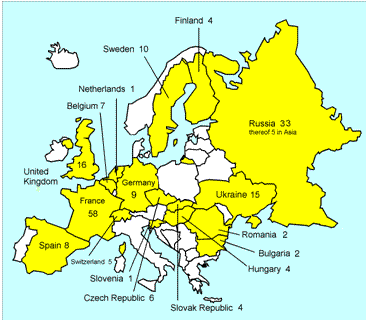
As of January 2013 there is a total of 185 nuclear power plant units with an installed electric net capacity of 162 GWe in operation in Europe (five thereof in the Asian part of the Russian Federation) and 17 units with an electric net capacity 15 GWe were under construction in five countries.
Nuclear power plants in Europe, in operation and under construction (2013) :
|
Country |
in operation |
under construction |
||
|
number |
net capacity MWe |
number |
net capacity MWe |
|
| Belgium |
7 |
5,927 |
–
|
–
|
| Bulgaria |
2 |
1,906 |
– |
– |
| Czech Repuplic |
6 |
3,766 |
–
|
–
|
| Finland |
4 |
2,736 |
1 |
1,600 |
| France |
58 |
63,130 |
1 |
1,600 |
| Germany |
9 |
12,068 |
–
|
–
|
| Hungary |
4 |
1,889 |
–
|
–
|
| Netherlands |
1 |
482 |
–
|
–
|
| Romania |
2 |
1,300 |
– |
– |
| Russian Federation |
33 |
23,643 |
11 |
9,297 |
| Slovakian Republic |
4 |
1,816 |
2 |
782 |
| Slovenia |
1 |
688 |
–
|
–
|
| Spain |
8 |
7,567 |
–
|
–
|
| Sweden |
10 |
9,395 |
–
|
–
|
| Switzerland |
5 |
3,263 |
–
|
–
|
| Ukraine |
15 |
13,107 |
2 |
1,900 |
| United Kingdom |
15 |
9,246 |
–
|
–
|
| total |
185 |
161,922 |
17 |
15,179 |
In terms of electricity generated by nuclear energy in 2011 France holds the top position with a share of 77.7 % followed by Belgium and the Slovakian Republic with 54.0 % and Ukraine with 47.2 %.
Vous devez être connecté pour poster un commentaire.