In February 2024, the Commission launched the European Industrial Alliance on Small Modular Reactors (SMRs) to « ensure the successful deployment of the first SMR projects in Europe by the early 2030s ». In fact, the European Industrial Alliance on Small Modular Reactors has adopted its first Strategic Action Plan, outlining ten specific and targeted actions to deliver over the next five years.
Looking to « highlight key enabling conditions, potential barriers and concrete milestones in view of the future development and deployment of SMRs in Europe » the European Commission has opened a feedback period between 06 November 2025 – 04 December 2025 for the public.
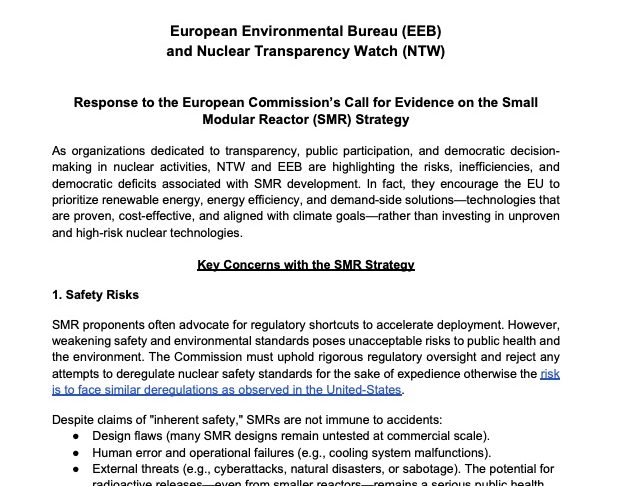
In this context, Nuclear Transparency Watch (NTW) and the European Environmental Bureau (EEB) have jointly proposed a feedback underlining important aspects to be addressed when it comes to SMRs. You will find a synthesis of their contribution below (Click here to read the complete feedback):
« As organizations dedicated to transparency, public participation, and democratic decision-making in nuclear activities, NTW and EEB are highlighting the risks, inefficiencies, and democratic deficits associated with SMR development. In fact, they encourage the EU to prioritize renewable energy, energy efficiency, and demand-side solutions—technologies that are proven, cost-effective, and aligned with climate goals—rather than investing in unproven and high-risk nuclear technologies.
Key Concerns with the SMR Strategy
1. Safety Risks
2. Financial Risks
3. Harmonization and Industrial Challenges
4. Lack of Openness, Civil Society Participation and Public Debate
The European Commission’s SMR strategy lacks transparency, democratic legitimacy, and economic rationale.
Instead of pursuing costly, unproven, and risky nuclear technologies, the EU must:
1. Prioritize real climate solutions—renewables, storage, and efficiency – over SMRs that may not be operational before 2040 and not as low carbon as promoted.
2. Uphold strict safety and environmental standards with no deregulation for SMRs.
3. Ensure full financial accountability: developers must bear all risks, not taxpayers.
4. Address nuclear waste and supply chain challenges with no false promises on « solving » nuclear’s inherent problems.
5. Prioritize open, inclusive decision-making: civil society must have a real seat at the table where critical thinking and democratic debates should take place with no more industry-driven narratives without scrutiny.
In short, the EU’s energy future must be transparent, participatory, and sustainable while SMRs fail on all counts. Therefore, we urge the Commission to seriously revise this very flawed strategy. »